
Lately, I’ve been having the same conversation with parents over and over.
“I think my child needs therapy.”
And sometimes, that’s true.
But a lot of the time, what I’m seeing isn’t a child who needs therapy first.
It’s a child who needs more support, more structure, and more skill-building in their everyday environment.
And parents who are exhausted, trying everything, and wondering why nothing is working.
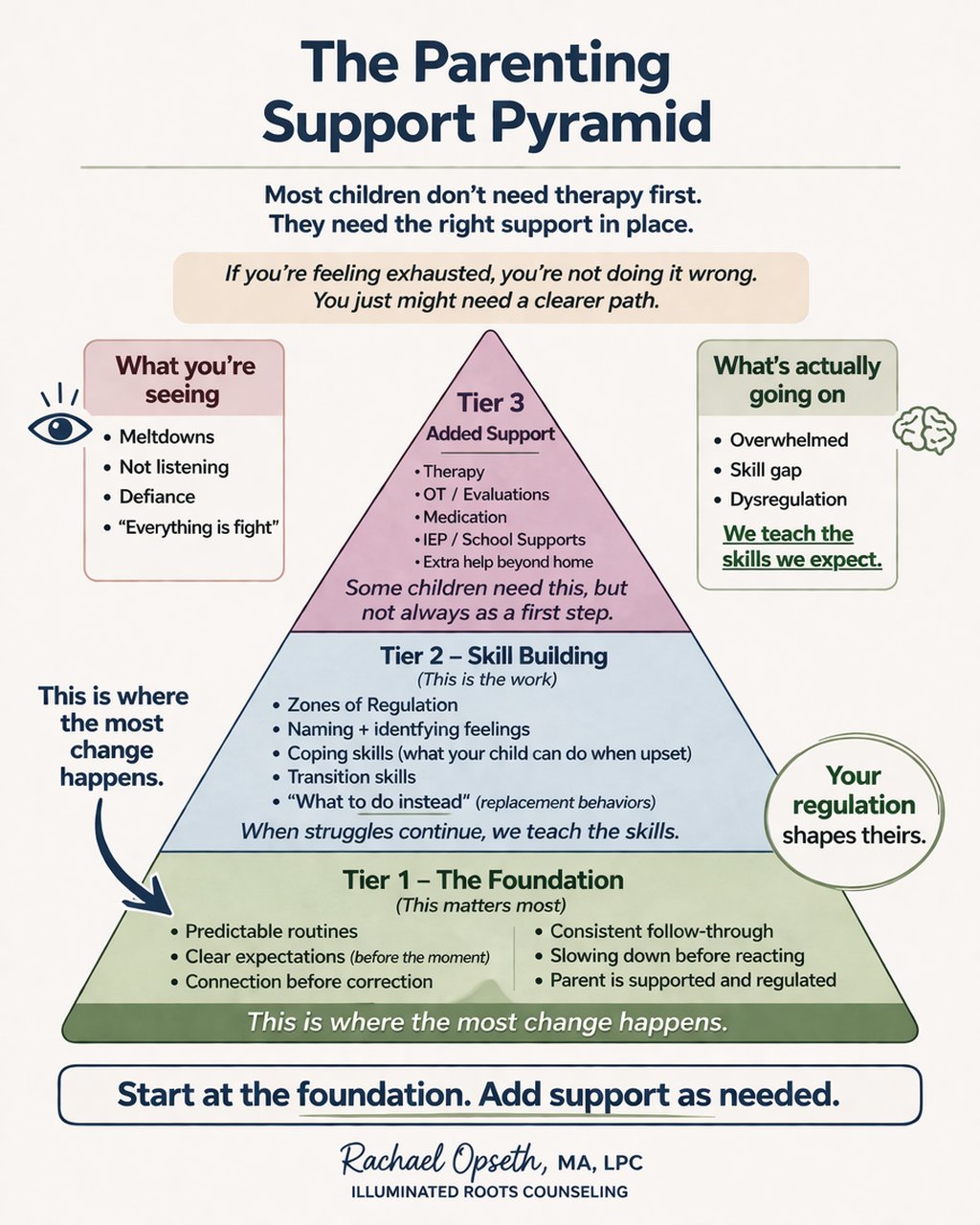
So I created something to help explain what I mean.
A visual. A reset. A different way of looking at behavior.
Where this comes from
Before moving into private practice, I spent over a decade working in schools as a school counselor.
I sat in countless meetings, supported students across a wide range of needs, and worked closely with teachers and families trying to figure out what actually helps kids succeed.
One of the most effective frameworks I saw used in schools was MTSS (Multi-Tiered Systems of Support).
And when it’s done right, it works.
It gives structure.
It creates clarity.
It prevents us from jumping straight to the most intensive interventions before building a solid foundation.
So this visual is inspired by that model.
Because honestly, why break a system that works?
What parents are seeing
Most of the time, parents come in describing things like:
- meltdowns
- not listening
- defiance
- “everything turns into a fight”
And it feels constant. Draining. Confusing.
What’s actually going on
Underneath those behaviors, I’m usually seeing something else:
- a child who is overwhelmed
- a child who doesn’t have the skill yet
- a child who is dysregulated
Not a “bad” kid.
Not a kid who needs to be fixed.
A kid who needs support.
The shift that changes everything
The biggest shift I try to help parents make is this:
Instead of asking,
“How do I stop this behavior?”
We start asking,
“What does my child need right now, and do they have the skills to handle this?”
Because when we expect skills a child doesn’t have yet, things escalate.
And when we slow down and teach those skills, things start to change.
Why I use a pyramid
I think about support in layers.
Not everything belongs at the top.
Tier 1: The Foundation
This is where most change actually happens.
- predictable routines
- clear expectations (before the moment)
- connection before correction
- consistent follow-through
- slowing down before reacting
- parents being supported and regulated
This is the work that doesn’t always feel exciting, but it’s what makes everything else possible.
Tier 2: Skill Building
This is where we teach what we expect.
- naming and identifying feelings
- learning coping strategies
- practicing transitions
- using tools like Zones of Regulation
- teaching “what to do instead”
If a child doesn’t have the skill, they can’t use it in the moment.
We have to teach it outside of the hard moment first.
Tier 3: Added Support
Sometimes we need more.
- therapy
- evaluations
- school supports (IEPs, accommodations)
- medication
Some children do need this.
But not always as a first step.
What this means for parents
If you’re feeling stuck, it doesn’t mean you’re doing it wrong.
It usually means:
- you’ve been trying to respond in the moment
- you haven’t had the support you need
- or your child is being asked to do something they haven’t learned yet
And that’s not a failure.
It’s just a signal to shift the approach.
Start here
Start at the foundation.
Add support as needed.
That’s it.
Not everything has to be fixed at once.
And not every hard moment means something bigger is wrong.
Sometimes it just means:
we slow down, we support, and we teach.
-Rachael
 English
  Spanish